Index Industries is building a tokenized product tied to a daily estimate of U.S. home prices. Its proposed structure combines an index, housing-related reserves, and minting and redemption at a price constrained by reserve value. That last feature matters: holding the token would not give an investor ownership of a home or a right to redeem at the index value in every circumstance.
As reported on November 13, 2026, the company announced a $50 million seed round on November 10, led by Lightspeed Venture Partners, with participation from Polychain Capital, Galaxy Ventures and Wintermute Ventures. It was co-founded by Josh Rosenthal, formerly president and general partner at Polychain Capital, and Brian Hardecker, founder and CEO of residential real-estate platform Longmark.

From a housing benchmark to a token
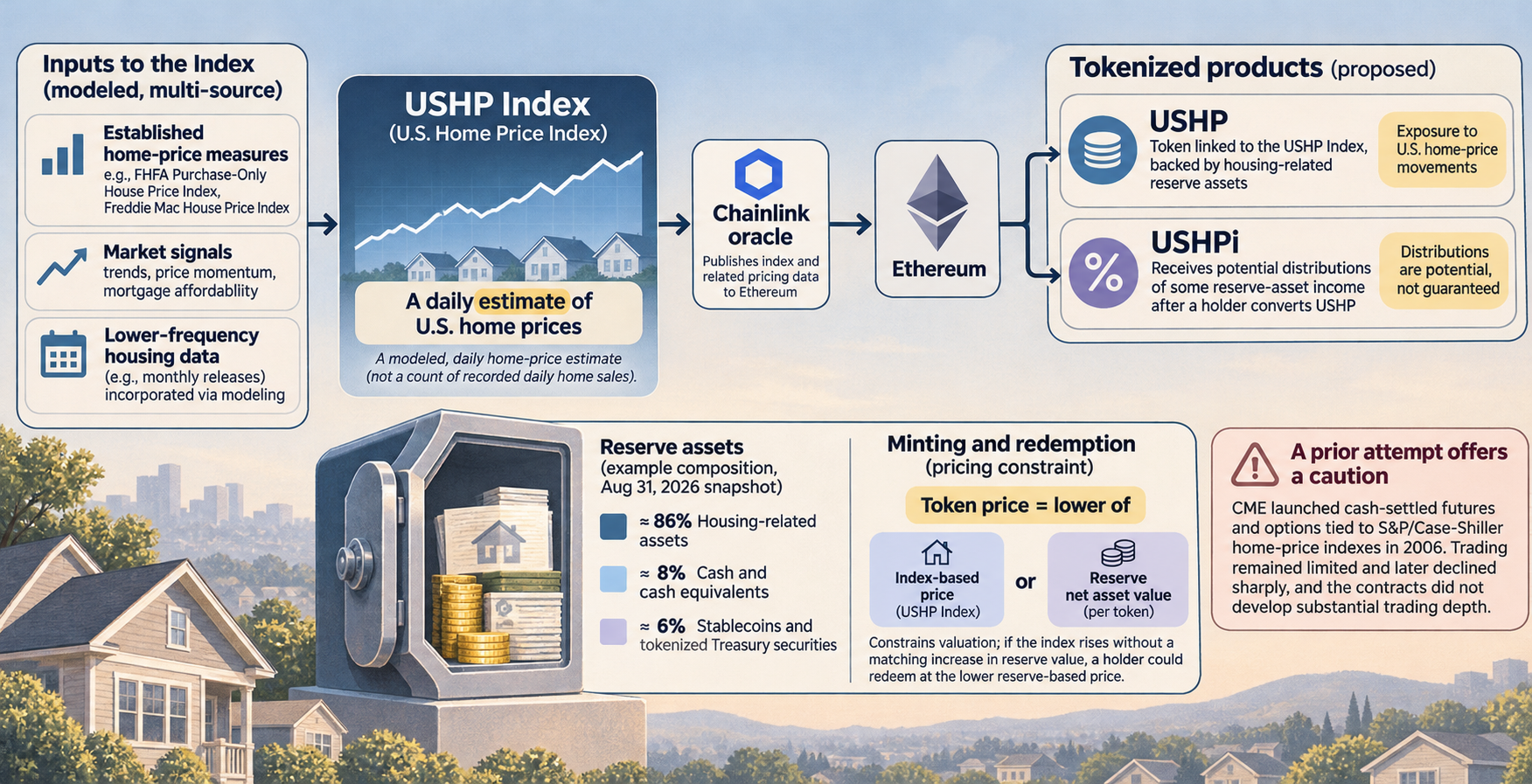
Index Industries says its USHP Index produces a daily national home-price estimate. The model draws on established measures, including the FHFA Purchase-Only House Price Index and Freddie Mac House Price Index, and incorporates signals such as trends, price momentum and mortgage affordability. Unlike a daily count of completed home sales, it is a modeled estimate built in part from housing data that is published less frequently.
The company says the index has operated live since March 2026; earlier figures are backtested or hypothetical. It also says mortgage and housing-data firm Andrew Davidson & Co independently reviewed the index methodology. Index and related pricing data are published to Ethereum through Chainlink oracles for use in the planned product’s issuance and redemption.

USHP Limited’s proposed USHP token would offer exposure linked to the index, backed by housing-related reserve assets rather than fractional ownership of individual properties. A second product, USHPi, is designed to receive potential distributions of some reserve-asset income after a holder converts USHP. The source does not establish that such distributions are guaranteed.
Reserves and the limits of redemption
In a reserve snapshot dated August 31, 2026, USHP’s website reported approximately 86% housing-related assets, 8% cash and cash equivalents, and 6% stablecoins and tokenized Treasury securities. Those are the disclosed composition figures for that date, not evidence that the entire reserve could immediately be converted to cash.

The described minting and redemption formula uses the lower of the index-based price and the reserve net asset value attributable to each token. If the index rises without a matching increase in reserve value, a holder could therefore redeem at the lower reserve-based price. The formula constrains valuation; by itself, it does not establish how readily the reserves could be sold or how redemptions would perform under stress.
The company has also secured up to $100 million in institutional funding commitments ahead of launch, according to the report. Galaxy and affiliates are expected to serve as institutional minters and liquidity providers, while Solana treasury company Forward Industries has committed up to $50 million. These commitments are distinct from Index Industries’ $50 million seed financing. Plans to connect USHP to lending markets, yield protocols and trading venues remain plans, not evidence of established trading depth.
An earlier market offers a caution
Index-based housing exposure has been attempted before. CME introduced cash-settled futures and options tied to S&P/Case-Shiller home-price indexes in May 2006. Its real-estate futures recorded 2,935 contracts traded in 2007, compared with 2.2 billion contracts across CME’s futures markets. In the first nine months of 2008, average volume fell 59% year over year and average open interest fell 70%. The contracts still existed at the time of the original report, but had not developed substantial trading depth.
USHP is not the same product as a cash-settled future: its design adds reserves and a redemption route. Whether that structure can support sustained demand and liquidity—and how its housing-related reserves behave when holders seek to exit—remained untested in the November 2026 reporting.