A weekly RWA roundup published on November 20, 2026, reported a smaller stablecoin market and sharply lower monthly transfer volume, even as its measures of active addresses and holders rose. The reporting period covered November 13–20; the market comparisons were against the same point in the previous month.
Stablecoin and RWA figures
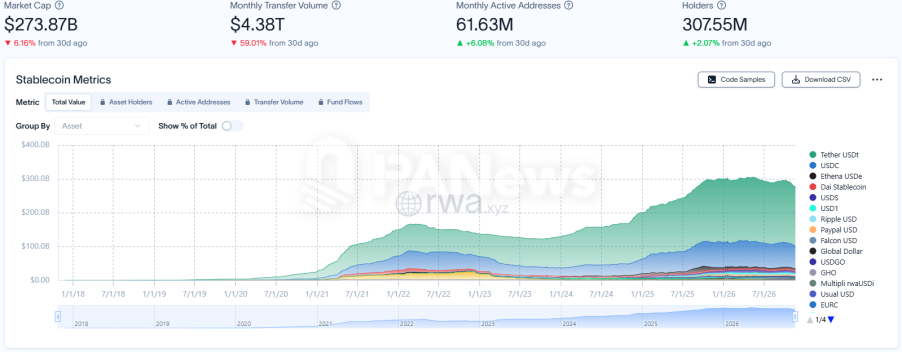
According to RWA.xyz figures cited in the roundup, stablecoins had a combined market value of $273.87 billion as of November 20, down 6.16% from the comparable point a month earlier. Monthly transfer volume was $4.38 trillion, down 59.01%. Monthly active addresses rose 6.08% to 61.63 million, while the reported number of holders rose 2.07% to 308 million. Those measures describe different aspects of activity; the increase in addresses and holders does not explain the drop in transfer volume.
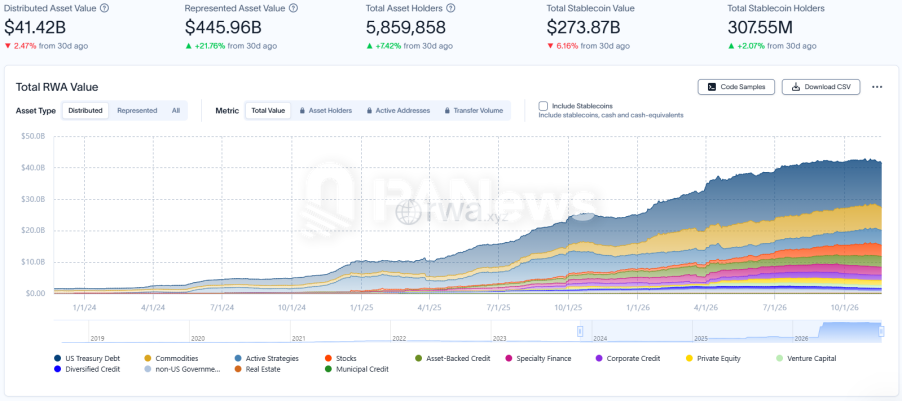
The roundup put the onchain market value of RWA assets at $41.42 billion, down 2.47% on the same comparison, while their reported holder count rose 2.42% to 5.8599 million. It reported month-on-month market-value declines of 4.31% for USDT, 0.03% for USDC and 0.07% for USDS.
Issuance and settlement developments
Several items concerned how digital money could move between institutions, rather than changes to stablecoin reserves:
- Hong Kong: The Hong Kong Monetary Authority said on November 16 that it was working with Swift and banks to explore interoperability between Swift’s ledger and the settlement layer of its Ensemble project. The focus is cross-border payments using multicurrency tokenized deposits.
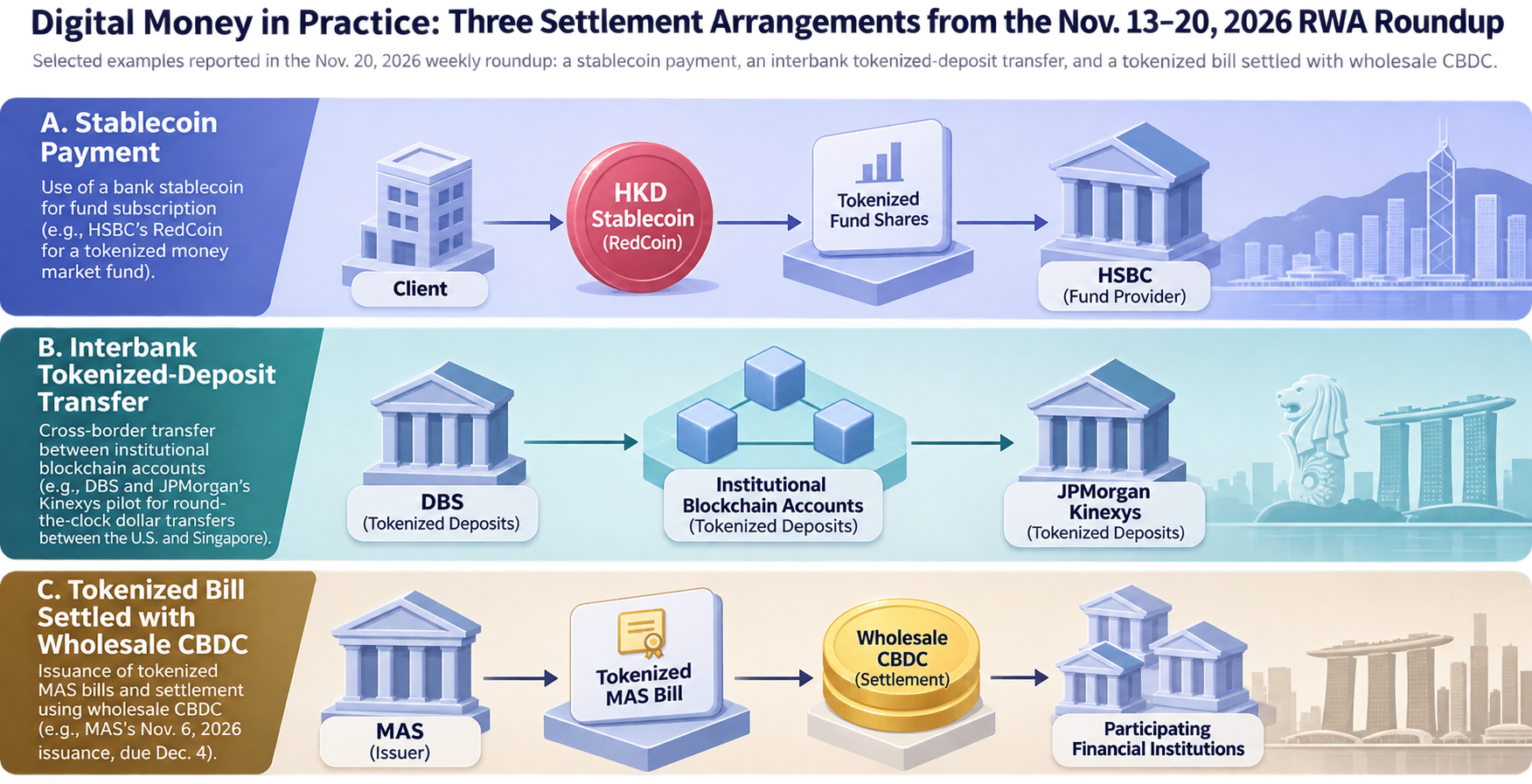
- Singapore: As reported by The Block, the Monetary Authority of Singapore issued S$100 million, or approximately $77 million, of tokenized MAS bills on November 6 and settled them using wholesale central bank digital currency. The bills were due to mature on December 4. MAS planned further trials; those plans were not completed issuances.
- South Korea: Citing ZDNet Korea, the roundup said a draft Digital Asset Basic Act expected that month would propose bank-led consortia for issuing won stablecoins. The proposal was not an enacted issuance rule. Exchanges and payment platforms could still compete to handle customer access and merchant settlement.
- World Bank Group: The group announced plans to explore disbursements using regulated dollar stablecoins and blockchain payment channels with Citi and Circle. Under the described arrangement, Citi would connect existing banking channels and Circle would handle USDC minting and settlement. The announcement described an exploration, not a completed shift of disbursements to USDC.
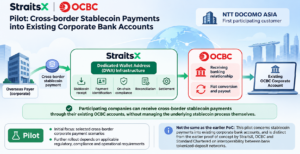
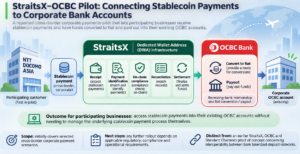
In tokenized-deposit tests, DBS and JPMorgan’s Kinexys introduced an interoperability arrangement intended to support round-the-clock dollar transfers between institutional blockchain accounts in the United States and Singapore. Separately, StraitsX, OCBC and Standard Chartered completed a controlled proof of concept for payments across their tokenized-deposit systems. The participants said legal, regulatory, operational and commercial questions remained before commercial deployment.
Funds, payments and company plans
HSBC said customers would be able to use its Hong Kong dollar stablecoin RedCoin to subscribe to a tokenized share class of its HSBC Global Money Fund – HKD, with a minimum of 100 RedCoin, equivalent to HK$100. Ant International, meanwhile, said it had piloted transactions with DBS and Franklin Templeton using its Whale orchestration protocol to coordinate delivery-versus-payment settlement between tokenized deposits and a tokenized money-market fund arrangement.
The roundup also reported that Invesco’s stablecoin reserve fund had begun issuing tokenized shares on Ethereum. Citing The Defiant and Etherscan records, it said the first issuance of 80,000 IROXX shares occurred on November 16. Under the fund prospectus described in the report, declared daily net investment income is automatically reinvested in newly minted shares at net asset value unless an investor elects cash. Superstate CEO Robert Leshner characterized the fund as compliant with the GENIUS Act; that was his claim, not a finding established by the roundup.
In other stablecoin-related developments, the Polkadot community approved a dotUSD strategy on November 11, with 97% support, according to the project. Later stages would allow users to lock DOT as collateral to mint dotUSD; the vote did not mean that mechanism was already operating. Japanese retailer Nippon Chokuhan was trialing JPYC payments on Polygon. On the financing side, Codex raised $30 million for its stablecoin-focused cross-border payments business, while Brazilian stablecoin infrastructure provider Avenia raised a $25 million Series A extension. Tether Capital also announced investments connected to Nomad, Stables and SCRYPT, including a $15 million investment in Nomad.