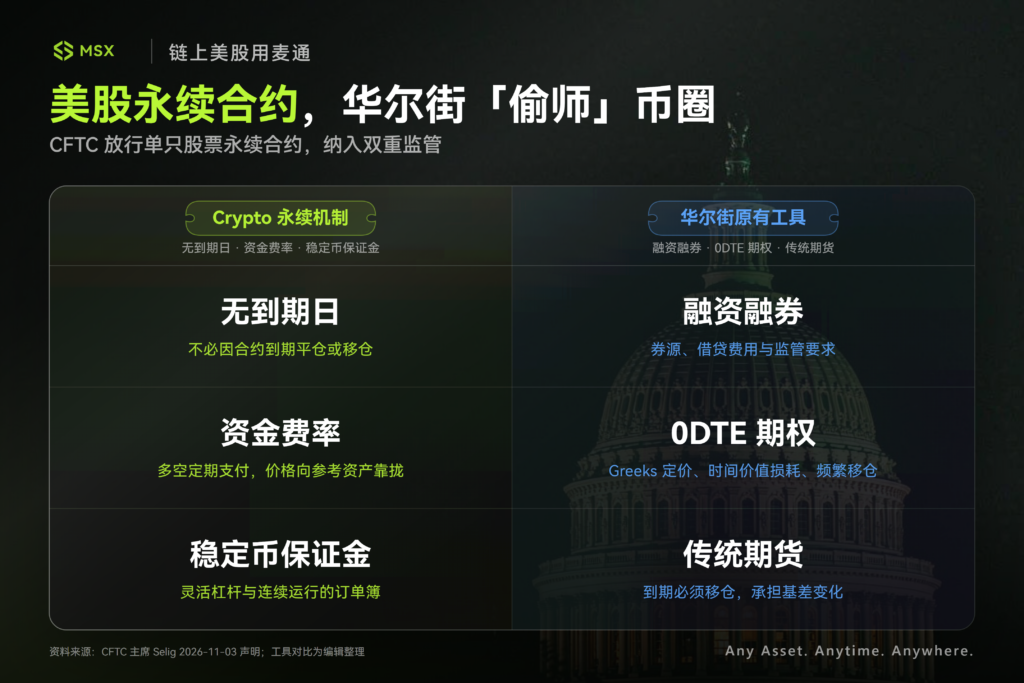
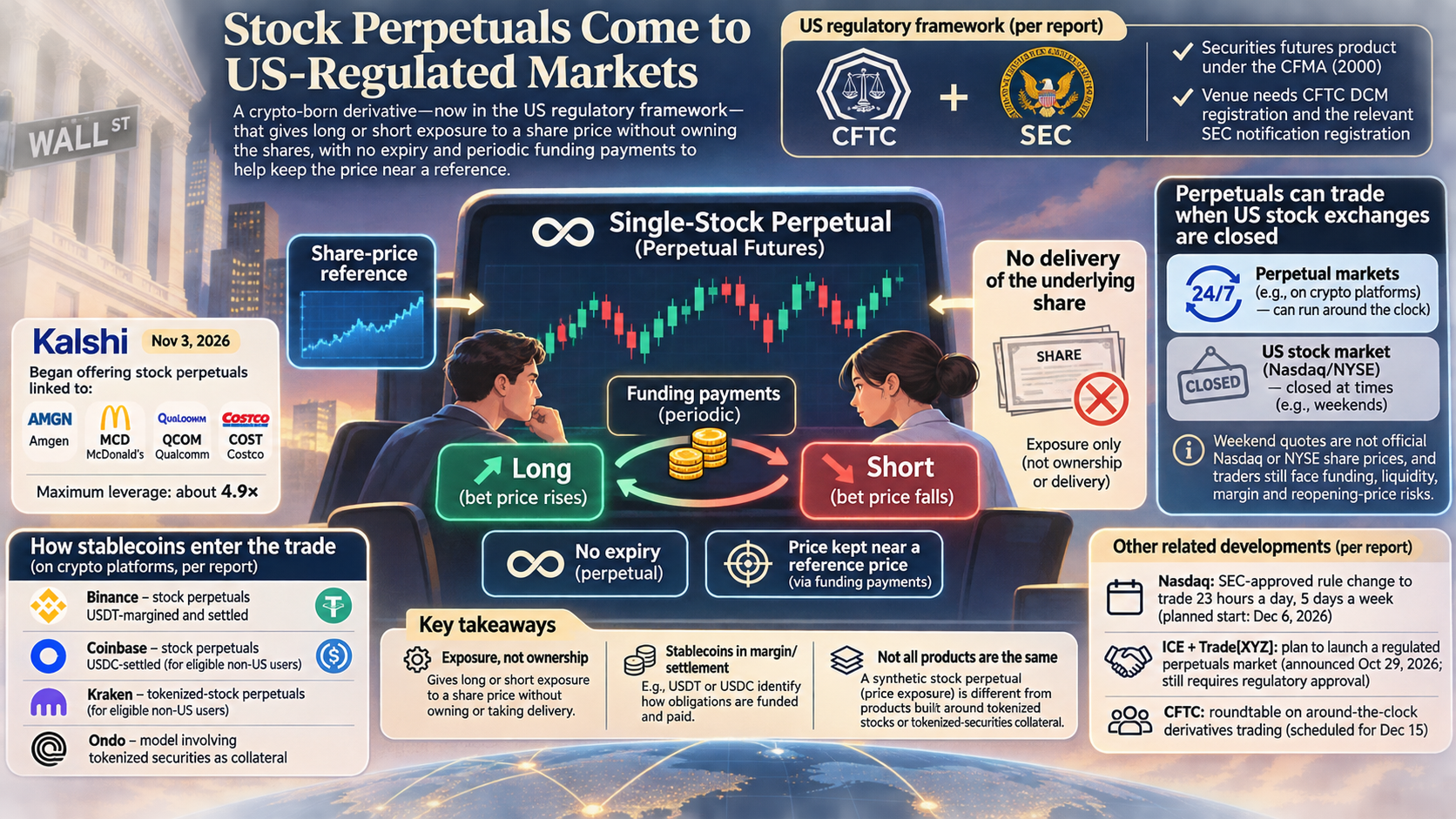
Stock perpetuals give traders long or short exposure to a share price without owning or taking delivery of the share. Unlike conventional futures, the contracts have no expiry date; periodic funding payments between long and short positions help keep their prices near a reference price. The mechanism was developed in crypto markets, where some stock-linked contracts use stablecoins for margin and settlement.
As reported on November 5, 2026, CFTC Chair Mike Selig said single-stock perpetuals could trade on US-regulated venues under a framework involving both the Commodity Futures Trading Commission and the Securities and Exchange Commission. According to Selig, these contracts are securities futures products under the Commodity Futures Modernization Act of 2000 and must comply with both commodity and federal securities laws. A venue offering them needs CFTC designated-contract-market registration and the relevant SEC notification registration to trade securities futures.
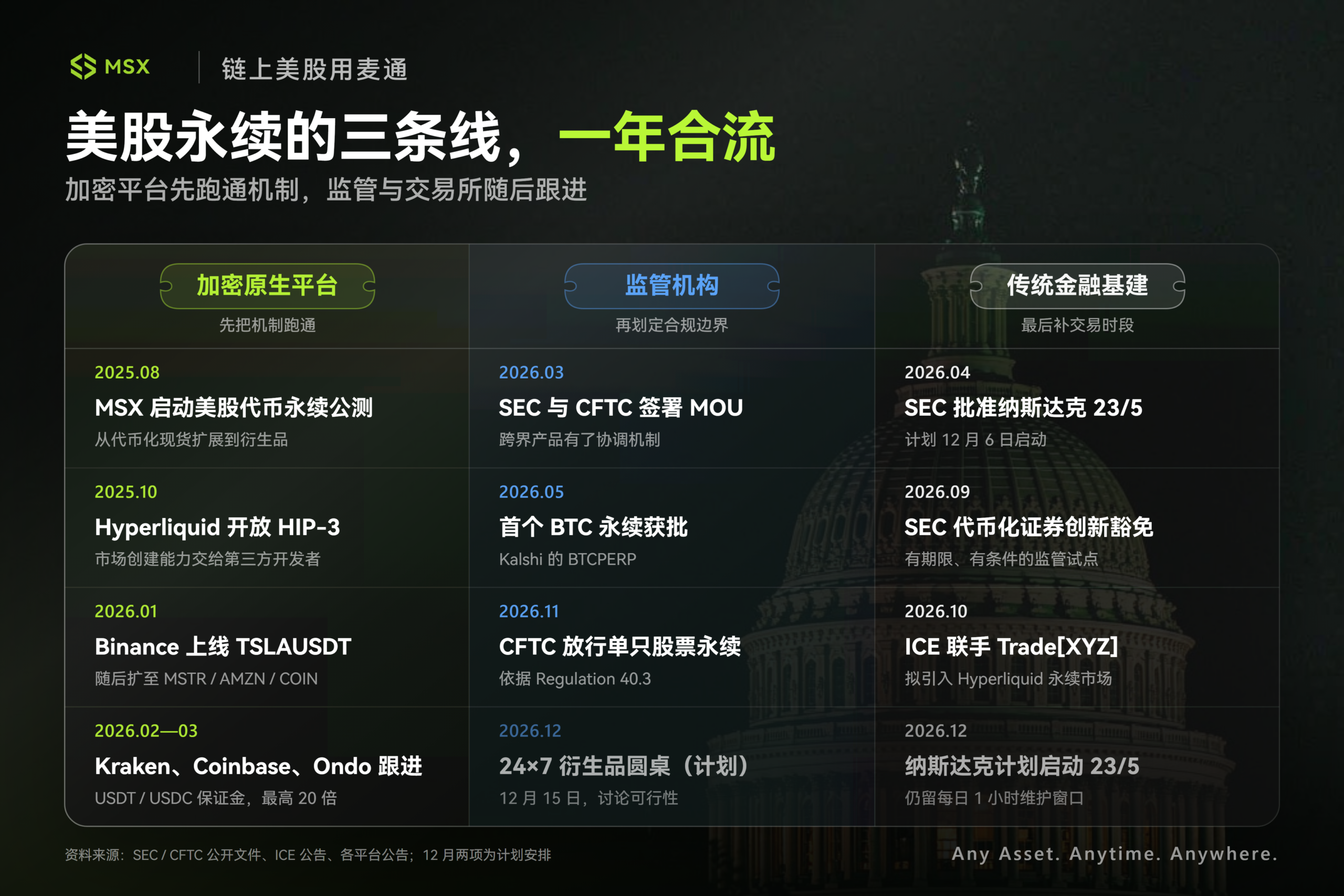
The report said Kalshi began offering perpetuals linked to Amgen, McDonald’s, Qualcomm and Costco on November 3, with maximum leverage of about 4.9 times. That is a development in regulated derivatives trading—not a change to ownership or delivery of the underlying shares.
Where stablecoins enter the trade
Crypto platforms had already been extending stock-linked perpetuals beyond crypto assets. The report described Binance’s stock perpetuals as USDT-margined and settled, and Coinbase’s as USDC-settled for eligible users outside the US. Kraken offered tokenized-stock perpetuals to eligible non-US users, while Ondo explored a model involving tokenized securities as collateral.
Those arrangements should not be treated as identical. A synthetic stock perpetual provides price exposure without delivery of the actual stock. A product built around tokenized stocks or tokenized-securities collateral has a different underlying structure. Likewise, using USDT or USDC for margin or settlement identifies how obligations are funded and paid; it does not establish anything about a stablecoin’s reserves or eliminate contract, venue or liquidation risk.
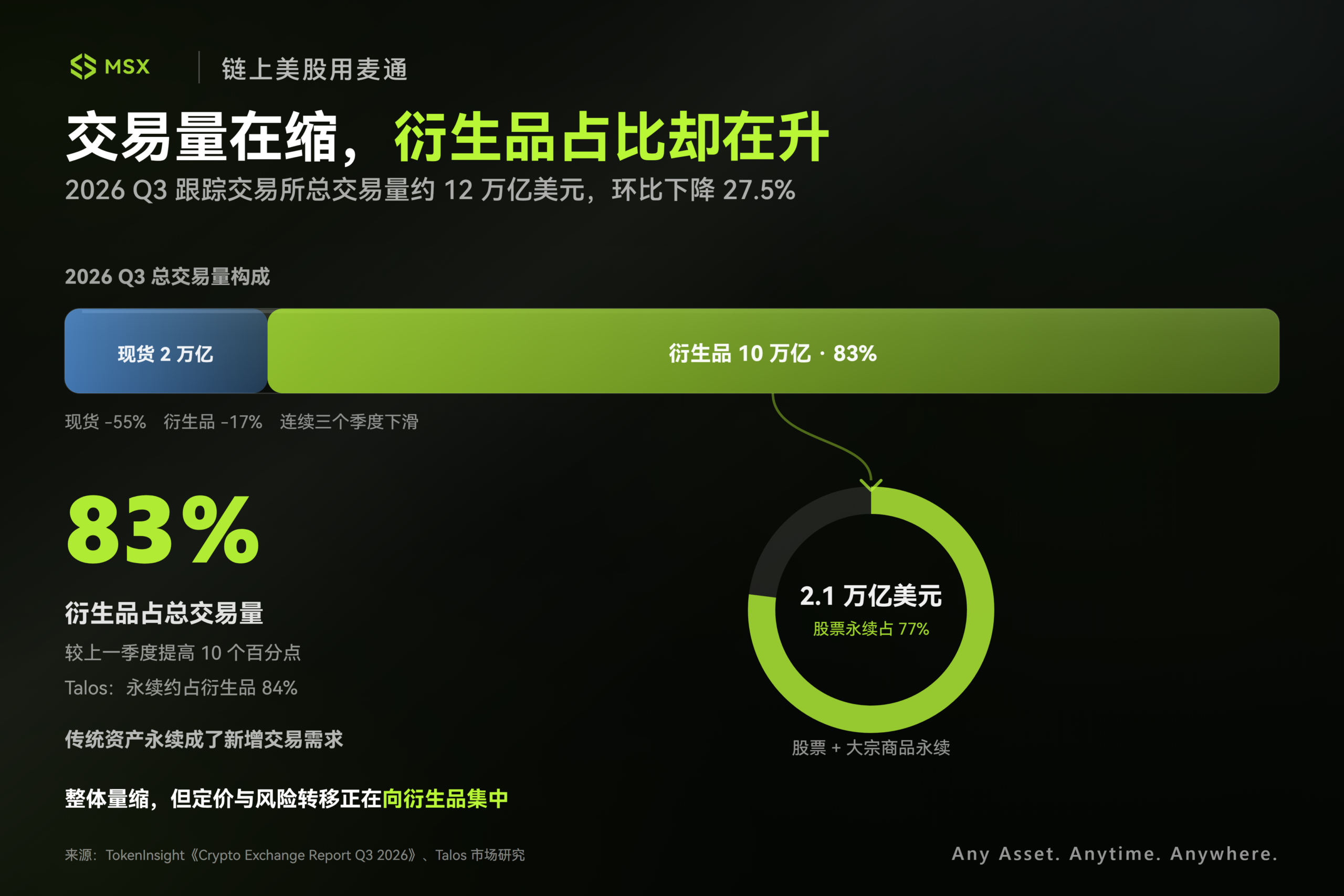
The scale helps explain the interest in bringing the structure to more assets. Citing TokenInsight, the report said the exchanges in its sample recorded about $12 trillion in total trading volume in the third quarter of 2026, down 27.5% from the previous quarter. Derivatives accounted for 83% of that volume. Across nine exchanges covered by the report, stock and commodity perpetuals generated a combined $2.1 trillion in quarterly volume, including about $1.61 trillion in stock perpetuals. These are reported trading-volume figures, not measures of stablecoin issuance or reserves.
A regulated market is not a 24-hour stock market
The report also described a planned US market involving Intercontinental Exchange, the New York Stock Exchange’s parent company, and Trade[XYZ], whose perpetual-market technology is based on Hyperliquid. Under the plan announced on October 29, ICE would operate a regulated trading and clearing structure and make a strategic investment in Trade[XYZ]. The proposed business still required regulatory approval; it was not an operating market at the time of the report.
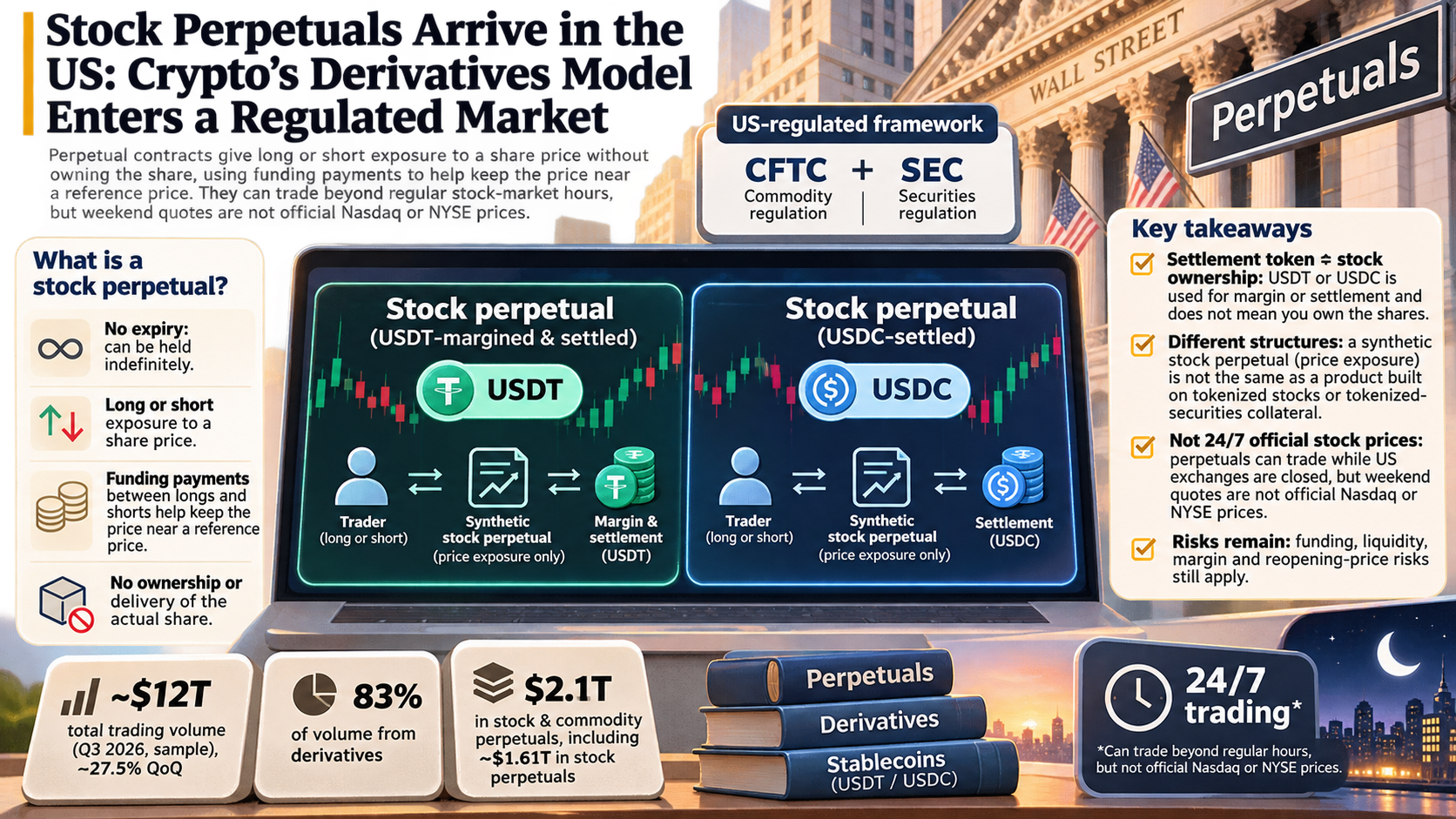
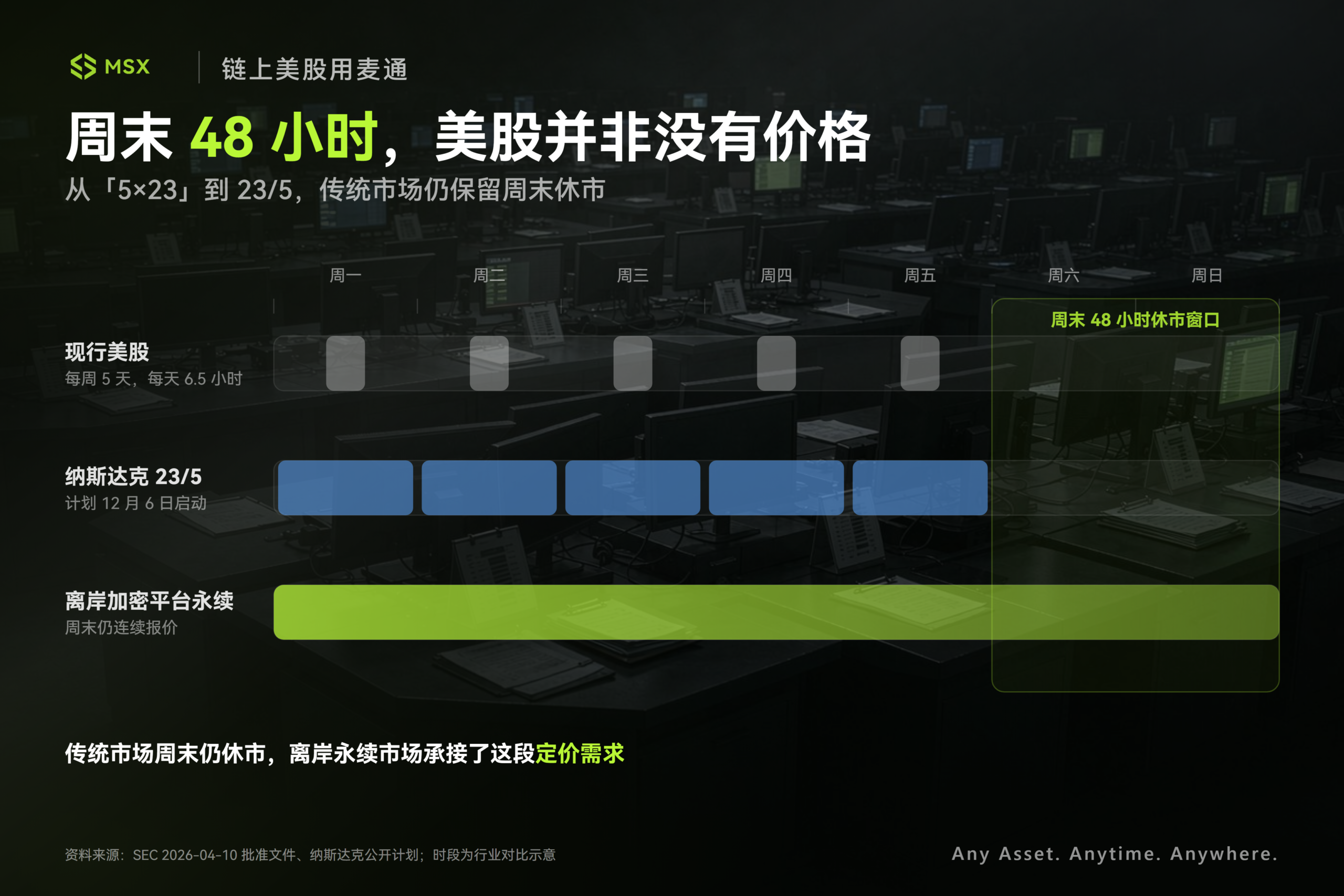
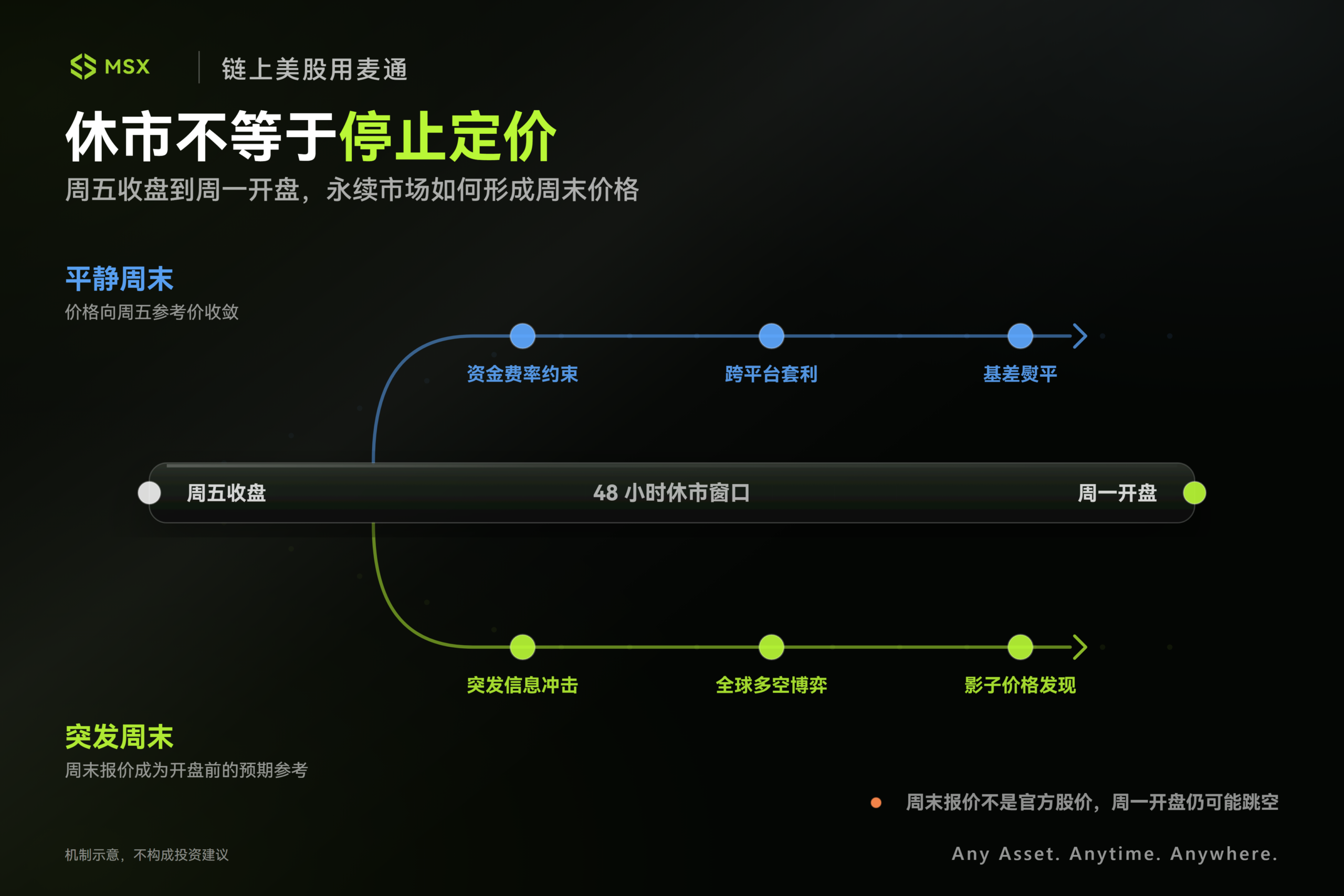
Perpetuals can trade while US stock exchanges are closed, but their weekend quotes are not official Nasdaq or NYSE share prices. The report described Coinbase’s use of external stock-price sources during normal sessions and an internal reference approach using available perpetual and tokenized-stock prices during some closed-market periods. Funding payments and trading across venues may narrow price differences, but neither guarantees an accurate reference price when the underlying stock market is shut. Traders still face funding, liquidity, margin and reopening-price risks.
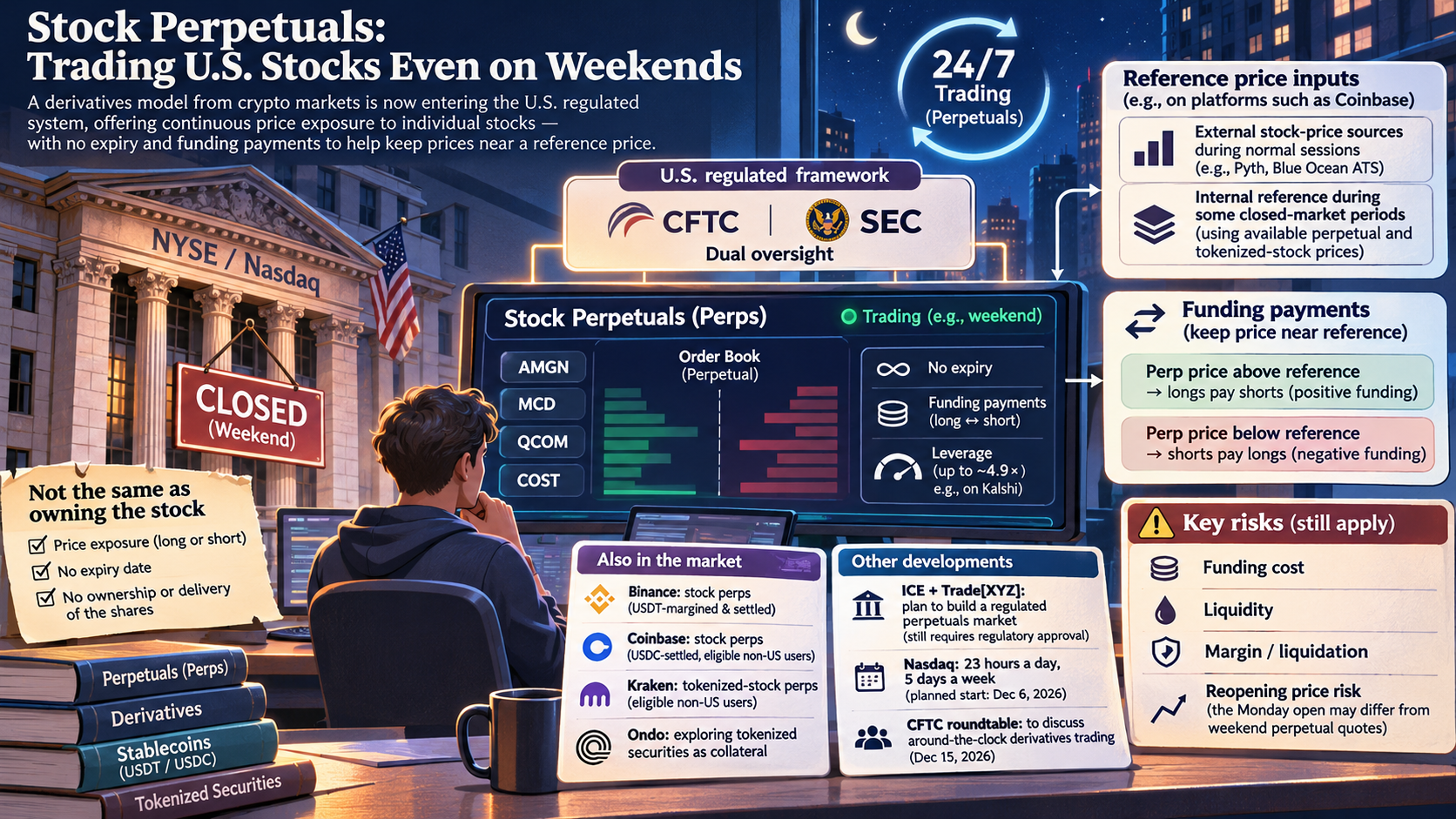
Other changes were at different stages. The report said the SEC had approved a Nasdaq rule change for trading 23 hours a day, five days a week, with a planned December 6, 2026, start. It also described a conditional SEC arrangement for certain tokenized-securities trading venues and a CFTC roundtable scheduled for December 15 to discuss around-the-clock derivatives trading. None of those steps, on its own, meant that US stock trading or settlement had become universally available 24/7.