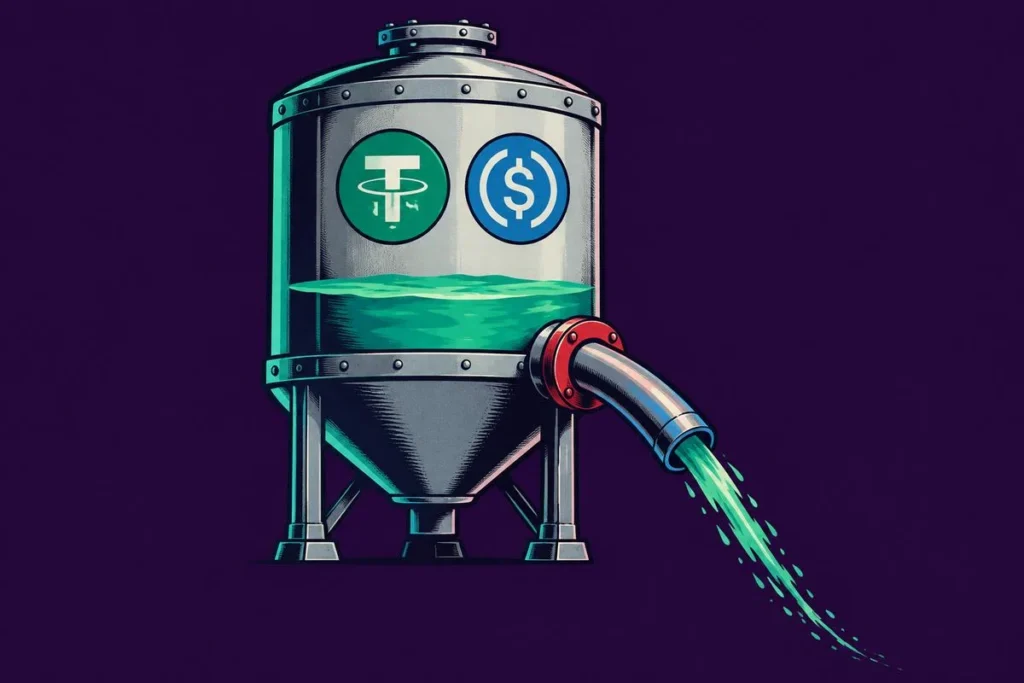
About $12 billion in stablecoins was redeemed across 11 tokens in the 30 days through November 13, 2026, according to Kaiko. Tether’s USDT and Circle’s USDC, the two largest stablecoins, each ended the period with roughly 4% fewer tokens in circulation. From November 13 to November 25, total supply fell a further 0.4%, while USDC supply edged up.
Ethereum accounted for nearly 90% of the 30-day supply reduction. The contraction was less pronounced on Tron, a network more commonly used for payments: its stablecoin supply fell 1.4%, Kaiko said. The redemptions coincided with withdrawals from US spot Bitcoin exchange-traded funds and a shift in expectations toward tighter Federal Reserve policy.
Trading slowed, but transfers exceeded the 2025 average
Daily volume in USDT trading pairs averaged about half its 2025 level over the month preceding November 25, Kaiko found. Transfers on blockchain networks showed a different pattern. USDT and USDC transfers averaged about $157 billion a day in the fourth quarter of 2026 through November 25, above the $130 billion daily average for 2025 but below the pace of the fourth quarter of 2025.
Bitcoin market makers continued to place orders close to the market price. According to Kaiko analyst Andrew Yang, the combined dollar value of buy and sell orders within 1% of Bitcoin’s market price fell about 15% over the month. Measured in bitcoin, the size of those same orders rose 9%.
What the contraction meant for trading liquidity
Yang interpreted the redemptions as capital leaving crypto rather than moving between crypto assets, leaving traders with fewer stablecoins available for purchases. Kaiko described the contraction as smaller than the one in 2022. Yang said rising interest rates and falling crypto prices drove months of fiat-backed stablecoin redemptions during the 2022–2023 bear market. Earlier in 2026, stablecoin supply contracted from mid-May into June before stabilizing in August.
For USDT alone, the decline was the largest since 2022, according to Julio Moreno, CryptoQuant’s head of research. USDT’s market capitalization fell $9 billion in the 60 days preceding November 25. Moreno linked that decline to a broader retreat from risk assets, including stocks and commodities. He noted that USDT supply was also shrinking when Bitcoin reached its November 2022 low.
Moreno tracks USDT supply as a gauge of funds available to trade, noting that exchanges hold 51% of the USDT circulating on Ethereum. In his view, stablecoin supply would need to grow again for trading liquidity to improve and the market to recover.