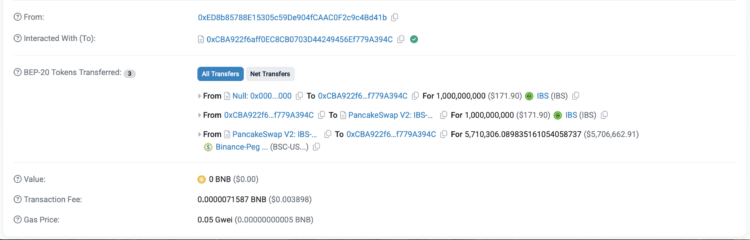
At 04:59 UTC on November 29, 2026, blockchain security firm Blockaid reported that a privileged POTS Money governance account had minted one billion IBS tokens on BNB Chain. The newly issued tokens were sold into the IBS/USDT pool on PancakeSwap. On-chain monitoring platform Lookonchain put the proceeds at approximately $5.71 million in USDT.
By 05:48 UTC, IBS was trading at roughly $0.00000008, according to CoinGecko data. POTS Money describes itself as a decentralized bond issuance protocol. Its algorithmic IBS token was designed to use collateral reserves and a price-support mechanism to maintain a minimum value of $1. That figure was a design objective, not the price holders could obtain in the pool.
What the liquidity lock protected
The liquidity lock restricted the ability of liquidity providers to withdraw the pool’s underlying assets. It did not prevent traders from exchanging IBS for USDT. The newly minted IBS could therefore be sold for USDT already in the pool without anyone having to unlock the liquidity.
The reported $5.71 million measures the USDT obtained through those sales, not total losses across IBS holders. The trades depleted the main source of liquidity for existing holders, but the financial impact on individual investors remained unknown.
Earlier audit flagged minting permissions
In a March 23, 2026 security audit, ScaleBit identified unlimited minting permissions as a centralization risk and recommended multisignature controls and a timelock. The finding was marked partially fixed. A separate historical CertiK record listed its review of POTS Money as in progress, with findings undergoing remediation.
As of November 29, it was unclear how the privileged account had been accessed or whether the incident involved the specific permissions ScaleBit had flagged. Researchers had reportedly identified a wallet associated with the USDT proceeds, but locating the funds did not establish that they had been recovered. No verified reimbursement plan was available.