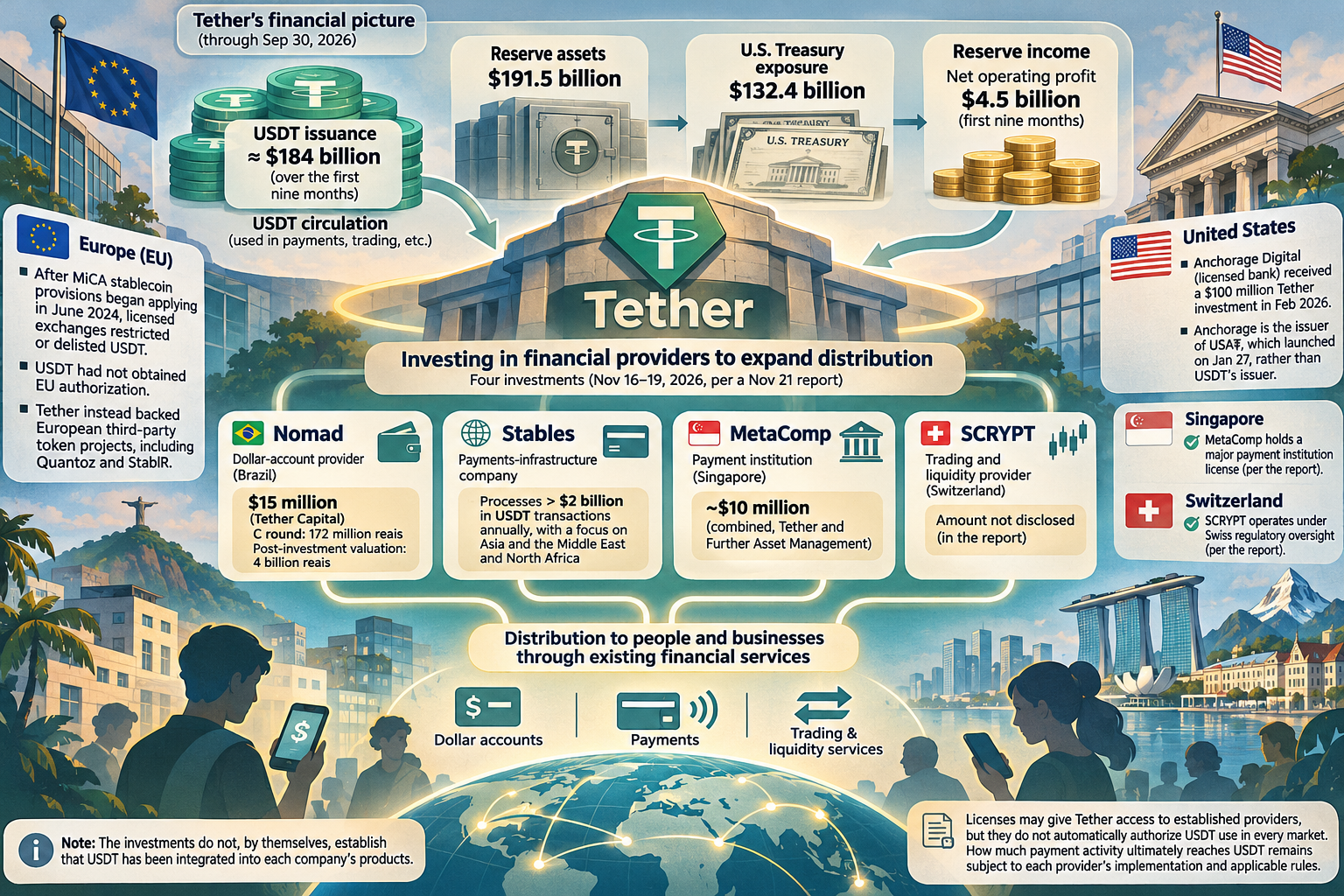
Tether invested in four companies between November 16 and 19, 2026, according to a report published on November 21. The deals span dollar accounts, payments, and trading and liquidity services. They do not, by themselves, establish that USDT has been integrated into each company’s products.
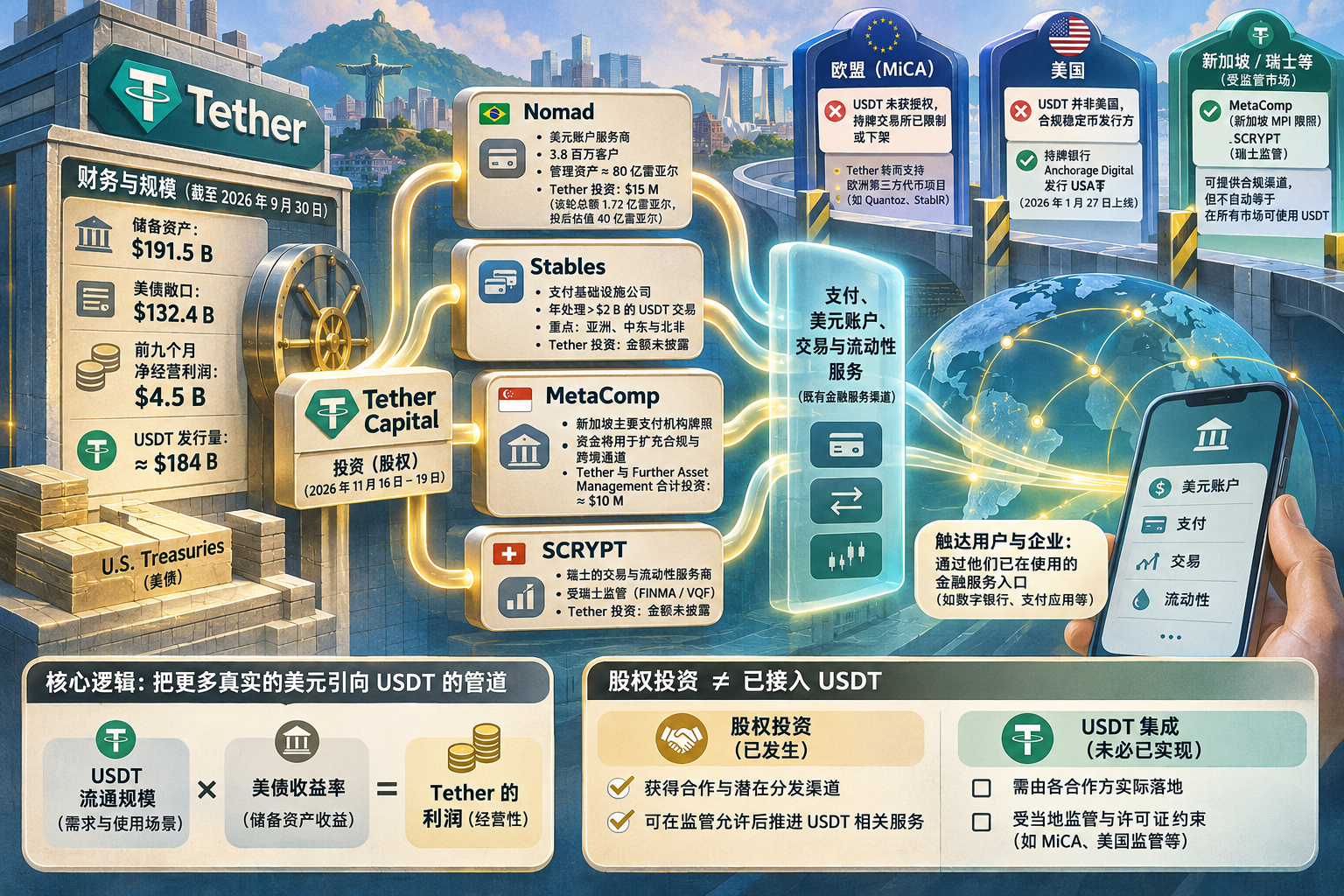
Tether Capital contributed $15 million to a funding round for Brazilian dollar-account provider Nomad. The round totaled 172 million reais and valued Nomad at 4 billion reais after the investment. Tether also invested in Stables, a payments-infrastructure company that the report says processes more than $2 billion in USDT transactions annually, with a focus on Asia and the Middle East and North Africa. In Singapore, Tether and Abu Dhabi-based Further Asset Management invested about $10 million combined in MetaComp. The fourth investment was in Swiss trading and liquidity provider SCRYPT; the report did not give an amount for the Stables or SCRYPT deals.
Reserve income and the search for distribution
The report frames the investments against Tether’s financial figures through September 30, 2026: $191.5 billion in reserve assets, including $132.4 billion of U.S. Treasury exposure, and $4.5 billion in net operating profit for the first nine months. It puts USDT issuance at roughly $184 billion over that period. Those figures describe different things: reserve assets and Treasury exposure are balance-sheet measures, while profit is income. The report’s comparison with 2024 profits also uses different profit measures, so it is not a like-for-like calculation.
Tether’s investment pattern, as described in the report, is to reach people and businesses through financial services they already use. Nomad has 3.8 million customers and manages about 8 billion reais in assets, but it has not announced a launch date for either USDT or Tether’s gold token, XAUT. Argentine digital bank Ualá, in whose financing Tether disclosed a $20 million stake earlier in 2026, has more than 11 million customers; local regulatory restrictions have so far prevented a near-term USDT integration, the report says. An equity stake is therefore not the same as an active USDT payment channel.
Licenses remain a constraint
The distinction matters in regulated markets. The report says licensed European exchanges restricted or delisted USDT trading after the EU’s MiCA stablecoin provisions began applying in June 2024; USDT had not obtained EU authorization. Tether instead backed European third-party token projects, including Quantoz and StablR. In the United States, the report identifies licensed bank Anchorage Digital—recipient of a $100 million Tether investment in February 2026—as the issuer of USA₮, which launched on January 27, rather than USDT’s issuer.
MetaComp holds a major payment institution license in Singapore, and the report says the new funding will expand its compliance and cross-border channels. SCRYPT operates under Swiss regulatory oversight. These investments may give Tether access to established providers, but their licenses do not automatically authorize USDT use in every market. How much payment activity ultimately reaches USDT remains subject to each provider’s implementation and the applicable rules.