MARA and Riot accounted for more than half the bitcoin sold by 14 listed companies through November 10, 2026, according to Lookonchain. But their disclosures show two different uses for the cash: MARA repaid bitcoin-backed debt, while Riot funded data center construction without selling new shares.
The distinction matters as mining revenue falls. Converting a mine into an AI facility can make better use of its power supply, but construction bills come due well before tenants start paying rent. Public disclosures as of November 25 showed no cancellations of signed leases. The more immediate questions were how miners would finance construction, whether they could deliver on schedule and how much investors would pay for the expected revenue.
Electricity absorbs nearly all revenue on some machines
Bitcoin had fallen more than 20% in November, at one point approaching $55,000, its lowest level since September 2024. At an electricity rate of $0.06 per kilowatt-hour, Antpool data indicated that power consumed at least 97% of revenue on newer machines including the Antminer T21 and WhatsMiner M60S series. The Avalon A1466I was already earning less than its electricity cost.
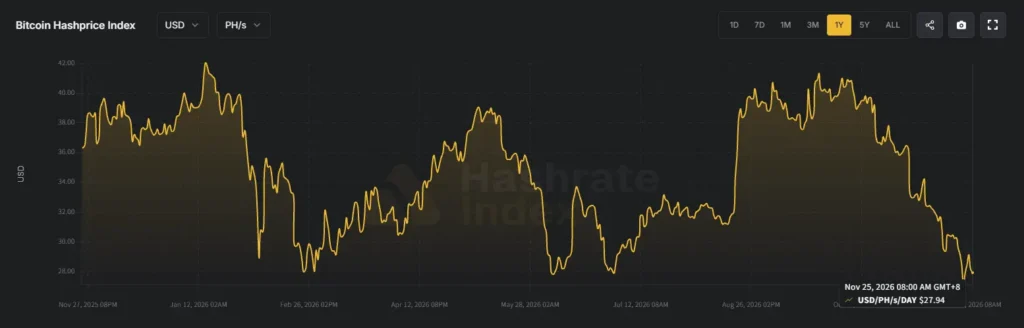
Hashprice, the daily revenue earned per unit of computing power, fell to $27.74 per petahash per second on November 25, near a one-year low, according to Hashrate Index. Yet the network’s seven-day average hashrate remained at 1,048.8 exahashes per second, with no sign of widespread shutdowns. Hashrate Index projected an increase of about 8.6% at the November 27 difficulty adjustment; the adjustment had not yet occurred.
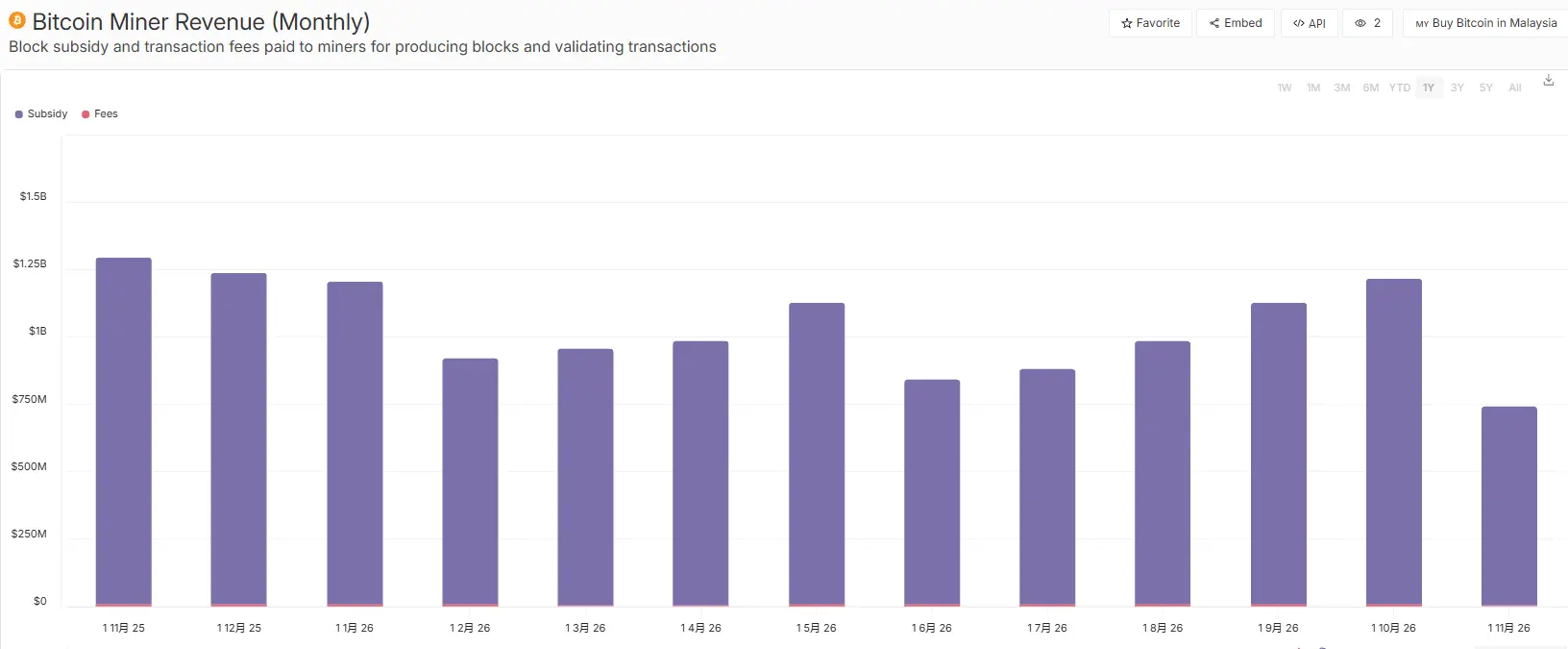
Newhedge put October miner revenue at approximately $1.215 billion, an 11-month high, against about $740 million in November through the reporting date. At that pace, November would finish well below October. Pressure on margins predated the decline: CoinShares calculated that listed miners’ weighted average cash cost to produce one bitcoin was about $75,500 in the second quarter, compared with a quarter-end bitcoin price of $58,400. Twenty One Capital CEO Rapha Zagury described the period as Bitcoin’s first hashrate bear market and said fewer listed miners could sustain large-scale operations.
Where the proceeds went
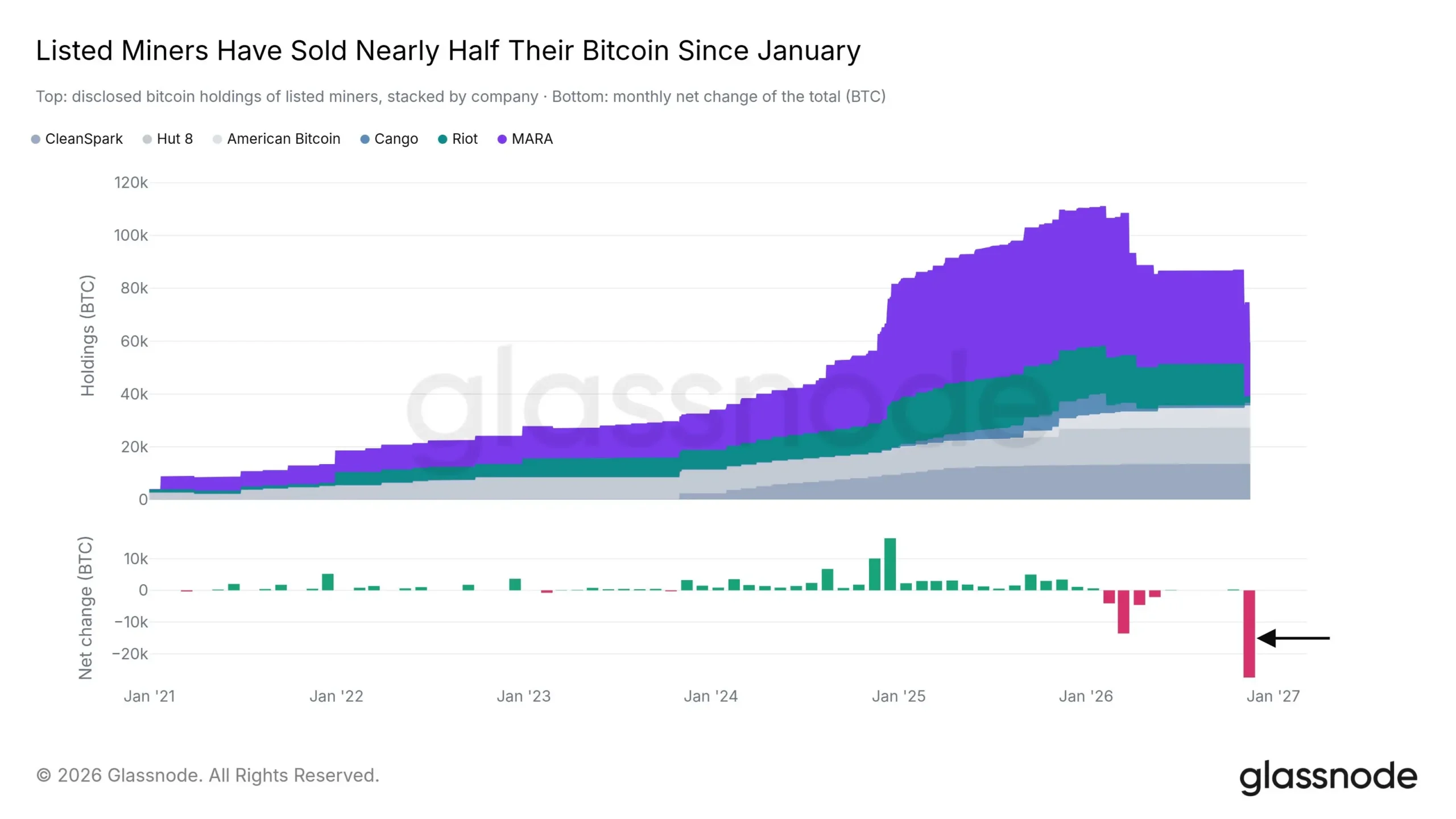
Lookonchain counted 108,247 BTC in sales, worth about $8.08 billion, by the 14 listed companies, most of them miners. MARA sold 40,581 BTC and Riot sold 20,264 BTC. Separately, Glassnode estimated that listed miners had sold nearly half their reserves since January, after years of retaining the bitcoin they mined and sometimes buying more. Its chart showed a net decline of about 27,000 BTC in November to date, the largest monthly drop on record.
MARA’s third-quarter shareholder letter illustrates why not all sales can be counted as AI spending. After quarter-end, it sold 13,597 BTC at an average of about $81,039, raising roughly $1.1 billion. Of that sum, $750 million went toward paying off bitcoin-backed loans. Earlier sales had helped MARA repurchase convertible notes with a face value of about $1 billion. Over the first three quarters, the company reduced debt by $1.4 billion, or 37%.
Riot, by contrast, reported raising about $1.5 billion from its 20,264 BTC sales in the first three quarters, primarily for data center construction. It had not raised equity in 2026 as of the report.
AI offers higher estimated profit, at a higher cost to build
CoinShares estimated annual profit of about $1.5 million per megawatt for AI computing, versus $500,000 for bitcoin mining. But it also put the cost of converting a mine to AI use at $8 million to $15 million per megawatt, more than ten times the cost of building a mine. BlocksBridge Consulting found that nine listed miners spent $5.11 billion on capital projects in the first half of 2026, about 15 times their $341 million in AI and high-performance computing revenue over the same period.
Investors had placed a premium on signed capacity. Benoît Pellevoizin, CoinShares’ managing director for France, said miners with contracted AI capacity traded at an average of 12.9 times forward sales, versus 3.7 times for those without it. In September, Grayscale renamed its bitcoin miners ETF to reflect a focus on AI computing, changed its ticker from MNRS to GCPU and switched its benchmark to the Indxx High Performance Computing Index.
The miners themselves were pursuing different businesses:
- Leasing facilities. Riot, TeraWulf and Cipher pursued long-term leases. Riot leased its entire Corsicana campus for 15 years under a contract valued at about $28 billion; its 10-Q identified Anthropic as the tenant. TeraWulf also signed with Anthropic, for 20 years and about $19 billion. Most lease deliveries and rent commencements were not expected until the second half of 2027 or later, and both companies had substantial long-term revenue tied to the same customer.
- Operating the equipment. IREN buys GPUs and sells computing services to customers including Microsoft. This gives it more exposure to growth in service revenue but leaves it responsible for GPU depreciation and exposed to customer concentration.
- Continuing to mine. Despite selling the most bitcoin in Lookonchain’s tally, MARA reported no signed data center lease. Its only signed AI deal was subsidiary Exaion’s four-year, $79 million GPU services contract. Its shareholder letter reaffirmed that bitcoin mining remained its core business.
Financing costs come into focus
On November 5, Bloomberg reported that Microsoft had tightened oversight of cloud infrastructure projects involving Nebius, IREN and Nscale, withdrawn from projects it considered risky and discussed internally whether to sign new contracts of that type. That same day, IREN moved its target for exceeding $4 billion in annualized revenue from the end of 2026 to January 2027, with a possible slip to February. IREN cited customer-requested design changes and supplier schedules.
Miner shares also swung during the period in which Nvidia CEO Jensen Huang was reported to have resigned on November 12 and been reinstated by the board on November 23. From November 13 to 20, Nasdaq closing prices showed IREN down 34.9% and MARA down 27.2%, compared with a roughly 15% decline in bitcoin. IREN rose more than 20% on November 23, then fell 11.54% the following day.
The companies’ funding exposures were more concrete than the share-price moves. IREN disclosed that about $6 billion of financing for its remaining fiscal 2027 capital spending had yet to be secured and depended on market conditions. Cipher agreed to cover the first $359.3 million in costs above the original budget at Barber Lake.
Riot management said on its third-quarter call that higher interest rates and wider credit spreads had prompted lenders to scrutinize tenant credit, power supply and delivery records more closely. Project financing for Corsicana was not due to begin until 2027. If Riot could not borrow on market terms, the tenant would advance about $3.6 billion for construction and recover it through rent offsets at an implied annual interest rate of about 12%.
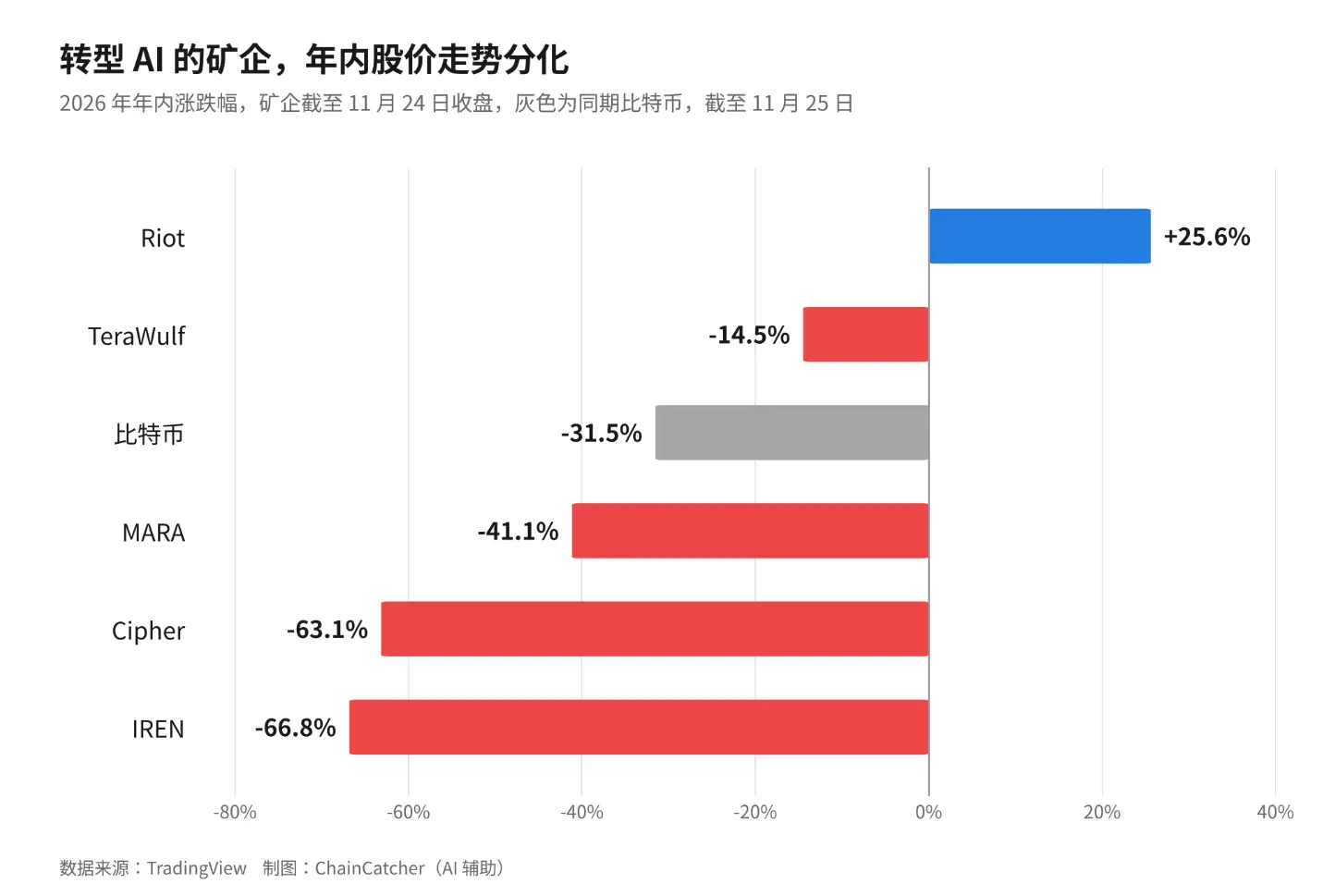
By the November 24 close, Riot was up 25.6% for the year. IREN was down 66.8%, Cipher 63.1%, MARA 41.1% and TeraWulf 14.5%, against a 31.5% decline in bitcoin. Those returns did not point to a single outcome for miners moving into AI: Riot had a signed tenant and had avoided equity financing, while IREN owned its GPUs and still faced a funding gap.
Who supplies Bitcoin’s next megawatt?
Hashrate Index projected the next Bitcoin halving for around April 2028, when the block subsidy is due to fall by half again. CoinShares analyst Luke Nolan said even a bitcoin price recovery would be unlikely to reverse miners’ shift toward AI.
In May, VanEck suggested that as US-listed miners redirect electricity to large AI customers, unused, government-controlled hydropower and natural gas resources could take their place. If that happens, sovereign entities and operators with low-cost energy could supply a larger share of the computing power that secures Bitcoin. For now, that is a possible change in who mines bitcoin, not an observed network-wide retreat: even near a one-year low in hashprice, the network’s hashrate remained above 1,000 exahashes per second.