On November 10, 2026, BlockBeats reported a discussion held that day in Yeouido, Seoul, citing Yonhap News Agency. The session was hosted by the Democratic Party of Korea’s AI finance and economy promotion group. Lawmakers taking part expected a government bill to come out within November 2026.
Payment use and the existing e-finance statute
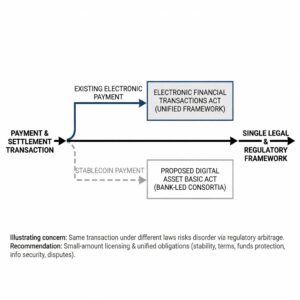
Shim Eun-seop (沈恩燮), director of the Electronic Finance Inspection Bureau at the Financial Supervisory Service, said that if stablecoins are used as electronic payment instruments, applying the Electronic Financial Transactions Act is unavoidable. He tied that view to fairness with existing electronic payment methods, user protection, and the stability of payment and settlement.
He said that if the same payment-and-settlement transaction were covered by different laws only because the payment instrument differed, regulatory arbitrage and confusion could follow. He argued for introducing a small-scale license under the Act for businesses that carry out stablecoin payment and settlement, and for applying duties on stability safeguards, the drafting and filing of terms, protection of top-up funds and settlement funds, protection of transaction information, and dispute handling.
He also said he fully agreed that anti-money-laundering obligations should be imposed separately on issuers, wallet providers, and payment-service providers.
Who may issue, and how payment systems connect
Kim Bo-il (金宝一), head of the Bank of Korea’s virtual-asset group, restated that stablecoin issuance should start with banks at the center. He said eligibility to issue should be broadened only after it is confirmed that the technology can connect effectively with existing systems and supervision. He described this as a compromise, put forward while no optimal plan yet exists, to reduce the risk that stablecoins are used to sidestep regulation.
He also said there should be a careful assessment of how far Korea’s national-level payment system depends on global private networks, and of how linkage and interoperability with existing systems should be designed.
According to Yonhap, in the government draft of the Digital Asset Basic Act expected to be published within November 2026, stablecoin issuers were expected to be mainly bank-centered consortia. That is Yonhap’s expectation about a draft not yet published in the report, not a description of enacted law.
Other views at the same session
Hwang Seok-jin (黄锡镇), a professor at Dongguk University, suggested that, compared with an issuance structure led by one particular industry, it would be preferable to let firms that meet set qualification and responsibility requirements take part.
Lee Dong-cheol (李东哲), chairman of the Credit Finance Association, said he hoped more parts of the financial industry would join won-stablecoin issuance consortia and each use their own strengths.
Namgung Seol (南宫卨), a headquarters head at Shinhan Card, said overseas stablecoin payment cases usually rely on the Visa network, and that if Korea wants to push early circulation in payments it may also need, to some extent, to use card-scheme networks.
The remarks concern proposed legal treatment and market structure. They do not, on their own, show that any stablecoin is insured, guaranteed, or redeemable on particular terms, and they do not describe reserve composition or an audit.
Original report: BlockBeats, November 10, 2026, 16:49 (UTC+8), citing Yonhap News Agency.