On November 10, 2026, officials discussed stablecoin payments at the Financial Investment Education Institute in Yeouido, Seoul.
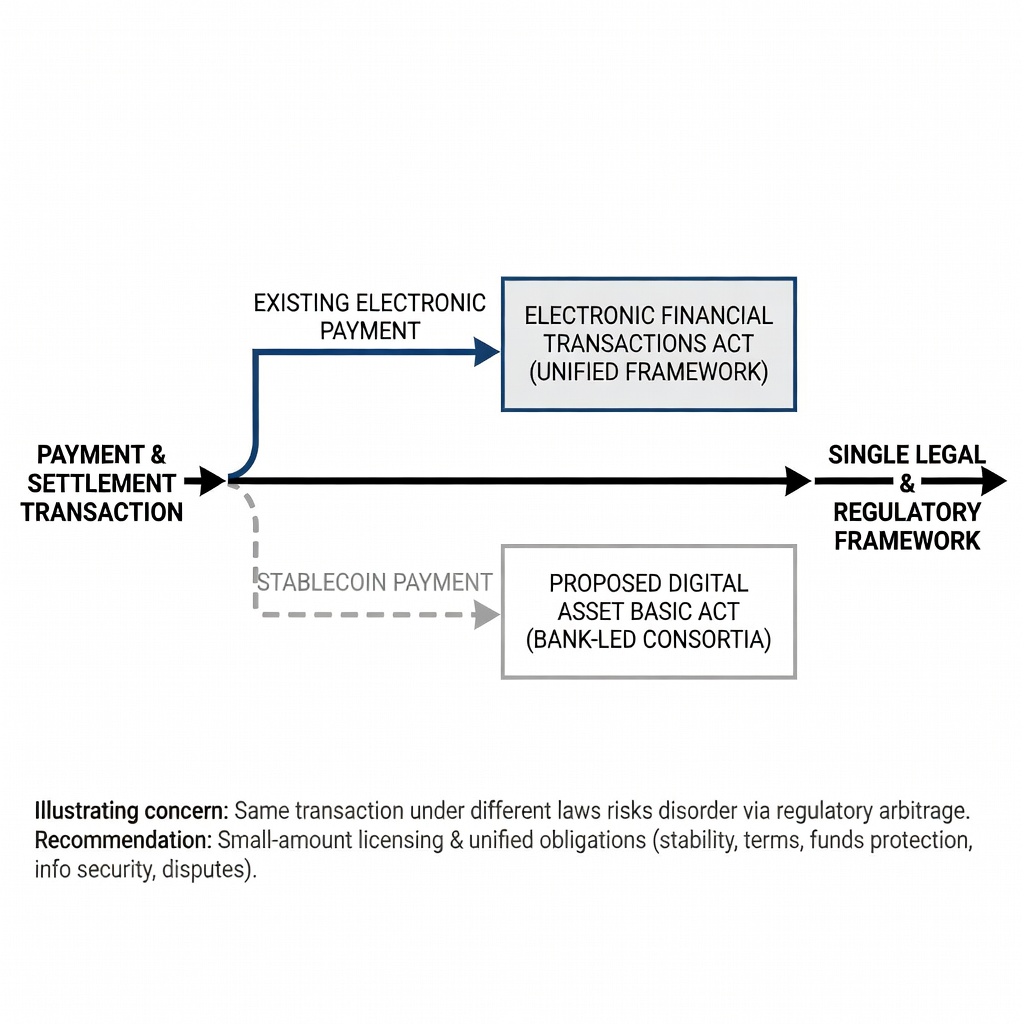
According to Yonhap News Agency, Shim Eun-seop, director of the Electronic Finance Inspection Bureau at the Financial Supervisory Service, said that if stablecoins are used as electronic payment instruments, applying the Electronic Financial Transactions Act would be unavoidable. He tied that view to fairness with existing electronic payment methods, user protection, and the stability of payment and settlement.
Shim said that placing the same payment and settlement transaction under different laws according to the payment instrument could create disorder through regulatory arbitrage. He recommended a small-amount licensing system under the Act. The obligations he described covered stability safeguards, preparation and filing of terms, protection of recharge funds and settlement funds, protection of transaction information, and dispute handling.
Kim Bo-il, head of the virtual-asset group at the Bank of Korea, said policymakers should consider how far a national payment system ought to rely on global private networks. He described as a compromise his earlier position that stablecoin issuance should begin with banks at the center and that issuer eligibility should be widened only after technical verification.
As of the November 10 discussion, the government draft of a Digital Asset Basic Act was expected to be released within the month, with stablecoin issuance expected to take the form of bank-led consortia. Those points were expectations attributed in the reporting, not a statement that a statute had already been enacted.
The remarks concern proposed legal treatment of payment use and issuance structure. They do not describe any stablecoin as insured, guaranteed, or always redeemable, and they do not equate a regulatory statement with an audit of reserves.
Original article, published November 10, 2026: TechFlow Post